

As you look at this now, there appear to be two distinct things occurring: one, the physicality of seeing, involving light on our retina, neurons firing in our brain, and reception in the occipital lobe. Second, the rapid interpretation of word-shapes into personal meaning. The latter is an idea, but seeing, the former [not the describing word seeing], is not.
If this consideration is applied to actually seeing ourselves in action, it can present some interesting questionings. It’s suggested here to reconsider the whole idea of questioning, this is not-knowing, per se. As a practical manner of not speaking. Although it’s noted for now, words are being used around this.
Seeing yourself as an idea is like looking into some thing. Seeing, actually, [not the word, actually] is not a thing, a looking into anything, particularly including oneself.
This can be rather difficult to meet, literally as difficult as I may want (or not want) to make it. Because seeing’s living moment is without any inner dividing whatsoever, is ever-present and cannot be actually looked into the way we ordinarily do, which seems as a separate thing to be seen. This is difficult, if not for a thinker-feeler impossible, to countenance.
Seeing now may not divide in the same way you read this text, or try to see into yourself. The very dividing is the divider. Seeing is the same as questioning.
For many people this can all feel rather pointless. It’s like a feeling, an idea of not getting anything or going anywhere. Psychologically, no destination. Here the viewing self quickly arrives at a conclusion within and about itself, yourself. A void that apparently has nothing to do with me. Even if wanting to, how is it to be seen? How suggests an answer in waiting, a knowing, a want; and questioning is not knowing, enquiring devoid of, without any history. This seeming void may include enquiry.
The sense of me, however, words, thoughts, emotions, etc, preoccupy their sometimes intense becomings rather than simply integrating, totalising inner/outer questioning, moment’s life presence underpinning all? A pointing, directing recall of self rises to emotionally attack/defend and secure its own memorising, identity at any cost, as all it knows. This is deeply, emotionally mostly unrealised conditioning.
Consider also perhaps for a moment that the thought-feeling of ‘here’ may likewise be psychological conditioning operating. While necessary in a number of areas to function as a human being, to understand speech, to read and write, to think about going from one place to another… all of this is also conditioning. Not the actual walking from place to place, but the thinking, the idea of walking from place to place.
Such conditioning is occasionally necessary, but when becoming, it, I repeatedly personalise - this, and that - it takes over, psychologically distances as seemingly a living (though memorised) centring self. / Such conditioning is occasionally necessary, but when becoming, repeatedly personalising, dividing - this, and that - it takes over, psychologically distances as seemingly a living (though memorised) centring self. One memorising as oneself becoming.
Most adult humans are very heavily conditioned as this, what is emotionally known. But may not feel that such a centre, a position, is apparently happening ‘now’ as they separate, memorise from instant living. An emotional or psychological response to this suggestion is conditioning.
Our conditioning has so memorised thoughts-feeling itself that I am regularly mistaking this self thinking-feeling for this moment’s actuality. And apparently, as such, the content of consciousness is rarely seen as content but thought-felt, conditioned as a completing and completed thing, like actual seeing but not so. Seeing, here, it’s suggested, is memoried, conditioning-seeing, not seeing per se. Even if I see myself as offering gratitude to life, or being kind and good, this too may unfortunately enfold unseen conditioning.
We may agree that memory is not real. So I am motivating to do, to become, an echo remember-er quickly remembering everywhere I go , who I am, or am seeing to be. This quickness is not present, but thinking-feeling memory memorising ‘presently’ into and as itself./ But are these quick remembrances actually present, or no more than thinking-feeling memory memorising ‘presently’ into and as itself? The moment’s dimension of the senses is not memory, does not [strange as it may seem] become or divide, is not seeing to be… moment already is.
What may be called memory echo is how self can harvest its own becoming. It, I, rest in a sense of was. I actually am was gathering a thrill, confirmation of that operating paradox new-memory. Mistaking this for really here. But memory, past tense, pending drawing everything into my apparent sense of was. / But really memory, past tense, drawing everything into my apparent sense of is, though actually was.
Was, feel, can be a hidden memoriser within the psyche, seeming present ordinarily, non-verbally drawing on all my emotional memories to build ever newer contributions to presently become (more, evermore memory).
The feeling of thought-feeling as was may bring moment into stark relief. This is especially so if all thinking is accompanied by a sense of urgently configuring was. If every moment thought-feeling appears there is a simultaneous sense of was, this may consider (challenge) the past-tense nature of a supposed present sense personal self. Possibly revealing less hidden moments as one’s habitual becoming, potentially making the moment more immediately present? Does this instigate play with psychological time that every thought was, and is not the feeling of is? Is, paradoxically, is not temporal in any sense and secures no dimension as memory. / Is, paradoxically not being temporal in any sense and securing no dimension as memory.
(Re-reading this with Eroteme in mind, with perhaps somewhat shorter pieces inviting questioning, wondering whether ending this here might not be a good idea … )
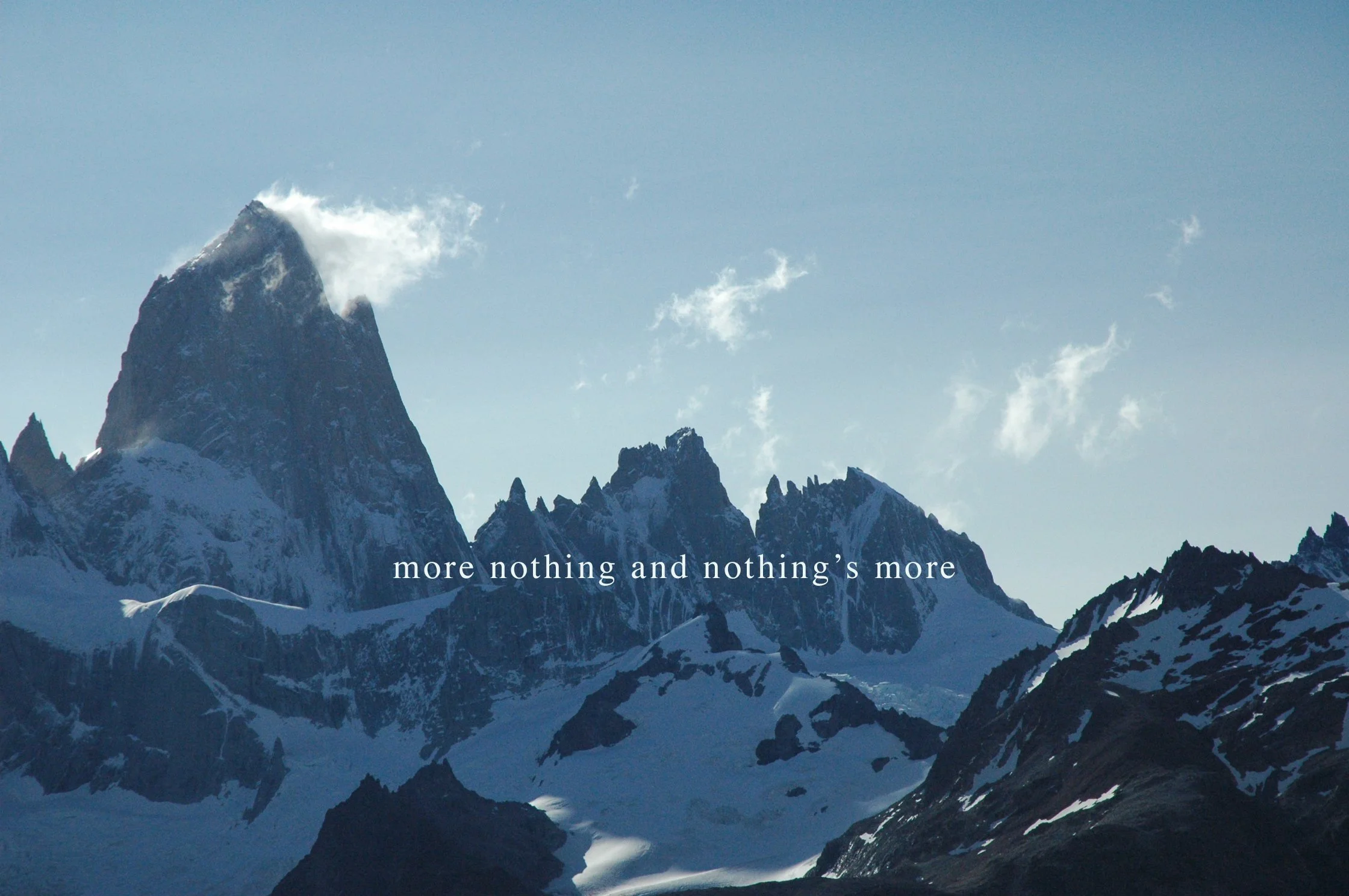


Moments without memory of becoming, thinking-feelings, emotionalising or naming are framed through, yet rarely seen, spatial silence. The profound and totalising nature of spatial-silence encounters all of rapid past-tense frameworking psyche in as much as psyche is time. This appears in challenging, in particular, the feeling of being present; that is, psychological time-making, to spatial-silence where there is no need. (and thought-feelings in their functioning and necessary place) / This appears as challenging in particular the feeling of ‘being present’, psychological time-making, as spatial-silence knows no need and thought-feelings are in their functioning and necessary place. This is because spatial-silence is not becoming, is not intruded memory and is timeless always (not the thought-feeling words) here / is timeless always here (not the thought-feeling words). Here, this is without locating.
(Wonder even whether this single paragraph above, dealing with spatial silence, might not be better placed / integrated in the piece ‘Space and Silence’ … and make another, separate piece of what follows from here on …?)
We place ourselves psychologically; as such, as a thing becoming, here. We may occasionally feel minor instability, slightly unstable (if you wish, check this for and as yourself) I would leave this out as the whole text will be embedded in a book inviting investigating and checking all of this for and as yourself, is it not?. Energy arises of, as jealousy, dislike, upset, uncertainty, and betrayal. Many kinds of stimulants (coffee, tea, dope, depressants, alcohol, pills, etc.), activities of a religious, political or social relationship, or like minds, seek to iron out these recurring tensions and sometimes irregularities. Belonging, supporting various organisations, may seem to secure more stable forms of relationships to help cope with the slightly unstable psyche, but the core, the root I may sometimes forget; then I ask, how can I be less unstable with my thoughts and feelings? But this is an ill put question because the prime root of this imbalance is wanting, a memoried wanting. So to end wanting, to ask how, at its emotional core, is utilising, engaging the very activity that makes for instability in and at the first place. Wanting to end want.
Simply suggested: I want to be less slightly unstable but wanting is, as itself(myself) unstable. Put another sense / way: wanting to be less unbalanced where wanting IS unbalancing. Wanting may be unnecessay emotional predicting wherein I secure my self memories into myself. But somehow I persist with what I know, I feel my knowing.
Into the everyday, more considering…
One’s life can include sometimes a flurry of minor irritations, occasional upsets coming and, hopefully, largely going. To maintain a sense of balanced becoming, such occasional discontent needs to be vanquished.
Psychologically then, we may feel these minor instabilities, slightly unstable energies of dislike, annoyance, impatience, touchiness, small emotional responses suddenly happening (along perhaps with occasional glimpses of happiness). As this root however, we remain slightly imbalanced, spending our day avoiding, dodging, dipping in and out as such sporadic thoughts and feelings that appear to attend.
A stubborn zipper jam. Dropping a raw egg on the floor. The milk carton being completely empty. Misplacing one’s keys, purse, or wallet right as you walk out the door. Hitting every single red light. Hanging on the "loading" screen. The "door closed" elevator miss. Your train/bus has just left.
Moments like these making what seems a nuisance or difficulty, creating slight upset, not getting where you need to be, nor working exactly the way you want (to return to a balanced, happy normality?) - these apparent inconveniences; all of this may be occurring for a purpose.
The moment’s intention is simply attentive presence regardless of the content of one’s engagement. This is what could be seen as moment’s purpose. What is present is totally free of memory, your or my memory. What is brought through words, thought-feeling memory, is acute inattention, self-memorising, mesmerising as moment. But perhaps consider: moment is never inattending, moment does not mesmerise? / (Again: I’d leave out ‘but perhaps consider’ and just make it a straightforward question:) But perhaps moment is never inattending, never mesmerising?
Considering is never mine, rather presence as inclusively not-knowing, questioning open to all. Presence, even what we think as nuisance, difficulty or instant silence, spatiality, impersonal alertness… even inattending, all is presence. Not disrupting your day, because disrupting is only disruption if it’s seen to be disrupting. Here, like quantum physics, the observer not only affects the experiment; the observer, observing, is the experiment. Experiment as not knowing, questioning….
Even if you get to where you or I wish to be, it’s actually the same moment is still waiting / it’s actually still the same moment. Moment’s intention is not about you or me, in fact there is no intention. Words, thought-feeling / in fact there is no intention, words, thought-feeling. The corridor of memoried mirrors echoes into (and against) itself; moment’s. The apparent unease of nothing happening is nothing happening, nothing doing, wherein unease may unfold questioning?
Questioning as unrealising dimensions.
1
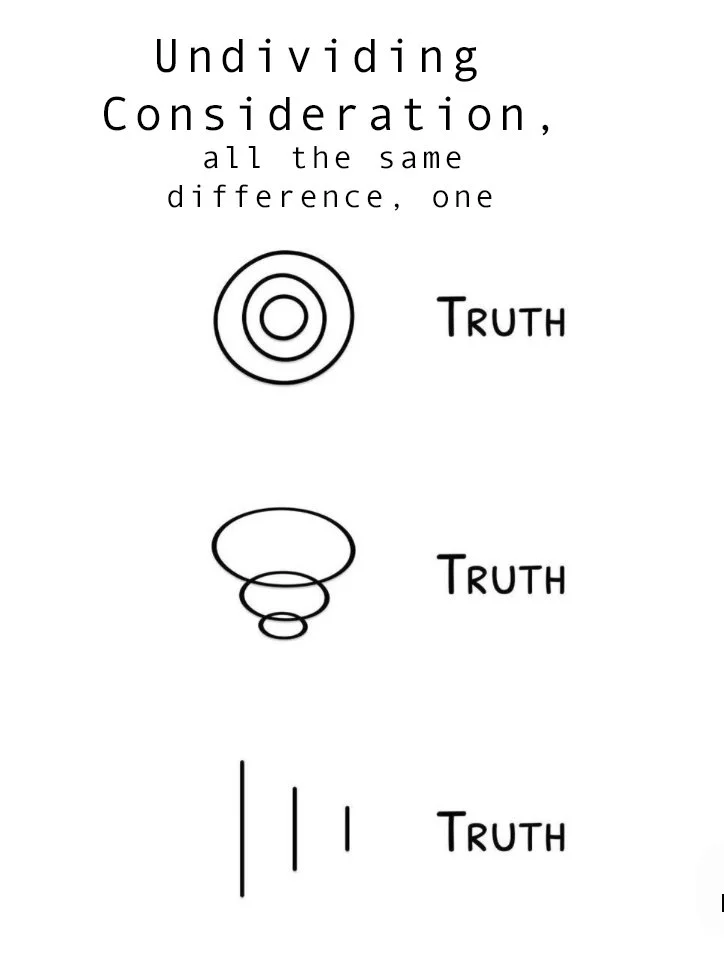
It can be challenging questioning life’s immense diversity, but questioning is challenge. The unknowing variety of life’s forever perspectives; other as self, immediate insights, multi dimensional truths without memory. Memory follows insight’s presence, seeing moments’ immediacy sans / without distance or separation, truthfully, factually: unknowing everything as unknowing nothing.
Nothing’s unknowing.
